The Definitive Guide to Church Simultaneous Interpretation Systems: Architecture, AV Integration, and Scaling
Release time: 2026-06-19
Table of Contents
As ministries expand their outreach, the transition to a multi-language congregation is a critical milestone. However, achieving seamless communication across diverse language groups requires moving beyond disruptive consecutive translation (where the pastor and translator take turns speaking).
The modern standard for inclusive worship is Simultaneous Interpretation (SI). By utilizing specialized wireless RF (Radio Frequency) hardware—often built on the robust architecture of commercial audio guide or whisper systems—churches can deliver real-time translation directly to congregants’ ears without altering the flow of the main service.
For church AV directors, procurement managers, and ministry leaders, selecting the right church translation system is a major infrastructure decision. This guide breaks down the technical architecture, hardware integration, and best practices for deploying a flawless SI environment.
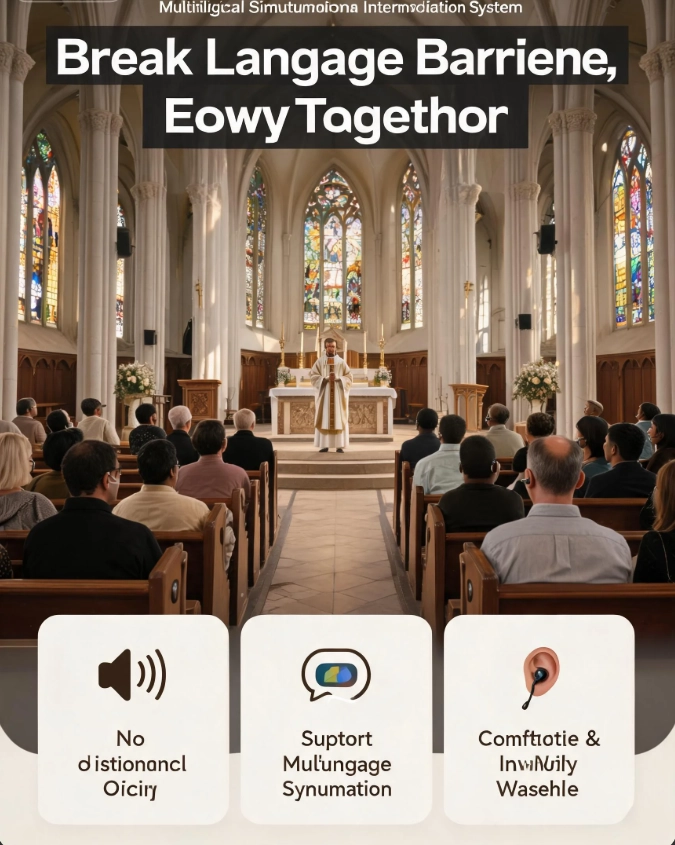
1. The Architecture of Church Simultaneous Interpretation
A professional church translation setup relies on a closed-loop audio distribution system. It must operate independently of the main PA system while maintaining perfect synchronization with the pastor’s message. The architecture typically consists of three components:
A. The Audio Feed (Input)
The interpreter needs to hear the pastor perfectly. Instead of relying on ambient room noise, the interpreter is usually fed a direct, isolated audio mix from the church’s primary digital mixing console (via Aux Send or matrix output) directly into their headphones.
B. The Transmitter (Stationary vs. Portable)
The interpreter translates the message in real-time, speaking into a microphone connected to an RF transmitter.
- Stationary Base Transmitters: For churches with a dedicated soundproof translator booth, a stationary desktop transmitter is ideal. These units typically feature professional XLR or 1/4-inch audio inputs, allowing direct integration with the church’s AV soundboard for superior audio quality and stable, high-powered signal broadcasting.
- Portable Bodypack Transmitters: If the church lacks a sound booth, interpreters use a “whisper system” bodypack. The translator sits in the back of the sanctuary with a highly sensitive headset microphone, whispering the translation as they move freely.
C. The Receivers (The Congregation)
Congregants who require translation are issued pocket-sized wireless receivers with standard 3.5mm earphones. They select their designated language channel and adjust their own volume, entirely isolated from the English (or primary language) audio playing over the church loudspeakers.
2. Solving the Multilingual Bottleneck: Multi-Channel Scaling
One of the most complex challenges in church AV is scaling to support three, four, or even ten languages simultaneously.
Standard analog UHF systems often struggle with crosstalk—where the Spanish feed bleeds into the Mandarin feed. To solve this, modern church translation systems utilize 2.4GHz Digital Frequency Hopping technology.
Digital systems offer distinct advantages for multi-language ministries:
- Absolute Channel Isolation: Digital packets ensure zero crosstalk. You can operate 50+ independent language channels in the same sanctuary.
- Global Compliance: The 2.4GHz ISM band is legally free to use worldwide, meaning satellite campuses or international church plants can use the exact same hardware inventory without applying for local radio licenses.
3. Hardware RF Systems vs. Wi-Fi Smartphone Apps
A common debate among church AV committees is whether to purchase dedicated RF translation hardware or use Wi-Fi streaming apps that allow congregants to listen via their own smartphones (BYOD). While Wi-Fi apps seem cost-effective, they introduce severe technical hurdles in a live worship environment.
The Latency Problem:
Wi-Fi audio streaming inherently processes data in buffers, creating a delay (latency) of anywhere from 1 to 5 seconds. If a congregant is watching the pastor speak but hears the translation 3 seconds later, it creates severe cognitive dissonance and ruins the worship experience.
Dedicated RF church translation hardware operates with sub-millisecond latency. The audio is transmitted at the speed of light, ensuring perfectly synchronized lip-sync and a natural listening experience. Furthermore, RF systems do not consume the church’s Wi-Fi bandwidth, which is often already strained by live-streaming equipment and congregation usage.
4. Technical Specifications for Church AV Procurement
When evaluating suppliers for church simultaneous interpretation equipment, AV teams should mandate the following specifications to ensure enterprise-grade stability:
| Technical Parameter | Standard Tour Guide Tech | Required Church SI Specs | Why It Matters for Worship |
| Audio Inputs (Transmitter) | 3.5mm Mic only | XLR / RCA / 6.35mm Line-in | Allows direct feed from the church mixing console (Yamaha, Allen & Heath, etc.). |
| Latency | 50ms – 100ms | < 10ms (Zero perceptible delay) | Ensures translation matches the pastor’s physical gestures and lip movements. |
| Signal Stability | Fixed UHF frequency | 2.4GHz with Auto-Frequency Hopping | Bypasses interference from wireless mics, in-ear monitors, and cell phones. |
| Receiver Display | Basic LED indicator | OLED with Battery & Channel ID | Allows elderly congregants or volunteers to easily verify they are on the right channel. |
5. Deployment & Volunteer Management
Even the most advanced audio equipment will fail if it is too complex for Sunday morning volunteers to manage.
Bulk Charging and Synchronization
Do not rely on individual USB cables or replacing AA batteries every Sunday. Invest in Integrated Charging Cases (typically 32-slot or 60-slot configurations). These heavy-duty cases allow volunteers to drop the receivers in after service. More importantly, premium cases feature a “Bulk Channel Sync” button, instantly resetting all 60 receivers to Channel 1 for the next service in three seconds.
Hygiene Protocols
In a post-pandemic landscape, sharing earphones is a concern. Churches should supply bulk single-use foam ear-pads, or encourage regular members to bring their own personal wired earbuds to plug into the receiver’s standard 3.5mm jack.
Conclusion
Upgrading to a dedicated simultaneous interpretation system is the easiest way to unite a multi-language church. Skip the smartphone Wi-Fi apps—they cause confusing audio delays. Instead, invest in dedicated wireless equipment that plugs directly into your soundboard.
Look for systems with drop-in charging cases so your volunteers aren’t constantly managing batteries. By keeping the tech simple and reliable, you guarantee that every member of your congregation hears the message clearly, in real-time, in their own language.